
Colour
Most jewellers use the GIA colour scale that uses an alphabetical scale from D to Z when discussing the whiteness or absence of colour in white diamonds. D represents truly colourless and white diamonds, which are very rare and the most desirable and so attract the highest price tags. As you travel through the scale closer to Z, you’ll find a greater presence of colour (yellow or brown).
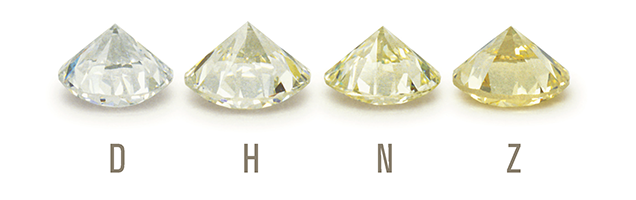
Most of these colour distinctions are only visible when compared to stones of different whiteness levels side by side. In reality, stones as far down the scale as H will appear white in isolation. Lower down the scale, you will start to notice a hint of yellow, especially when the stone is set in a white metal such as Platinum and Palladium as it will contrast in tone. Set in a coloured metal such as yellow and rose gold, or non-rhodium plated white gold, any yellow present in a diamond will be less noticeable. The colour of a diamond can be a good area to compromise when working within a budget as the setting style and metal colour can greatly affect the visual interpretation of the colour.
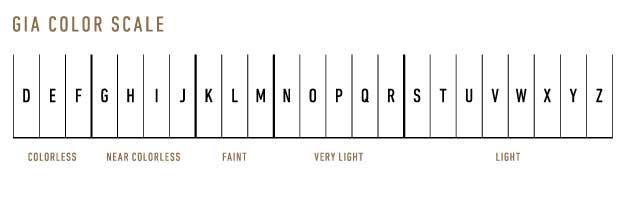 Before the GIA devised this D-Z grading system, other systems existed but were inconsistent. These included letters of the alphabet starting at A, with multiple A’s describing the best stones. Other grading systems have included Roman numerals or numbers. The GIA wanted to disassociate from these inaccurate systems and so devised this current system starting with D rather than A, as it is not a letter normally associated with top quality. The number of levels between D and Z makes it easy to accurately grade a diamond.
To find out more about the colour of diamonds, visit my blog post all about the 4 C’s of Diamonds